

Have you noticed how the different industries are transforming due to 3D printing? 3D printing technology is transforming the manufacturing industry especially the automobile, aerospace, and health industry, between the initial stage prototyping to mass-manufacturing.
Besides discussing the basics of 3D technology, this guide will discuss the applications of 3D printing and why CNC machining services are steadily implementing this new technology. This all-inclusive resource will give you all the information you need to keep on top of the 3D printing market, regardless of your level of experience.
Understanding 3D Printing Services
3D-Druck, also known as, Additive manufacturing is the technology of producing physical objects, typically three-dimensional, by depositing a material onto a base layer in a digital shape. This is opposed to the traditional manufacturing of subtractive products of subtractive manufacturing involving cutting away of material on a solid block.
The 3D printing technologies presently used are several, and include:
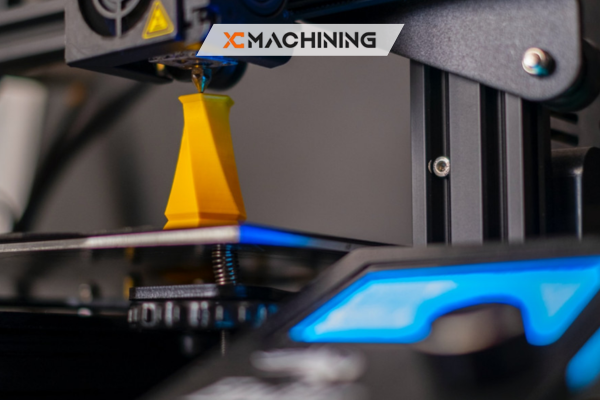
- Fused Deposition Modelling (FDM): This additive method creates layer upon layer by extruding thermoplastic filaments through a heated nozzle.
- Selektives Laser-Sintern (SLS): A powdered material, such as plastic, metal, or ceramic, can be laser-sintered into solid shapes.
- Stereolithographie (SLA): This method uses ultraviolet light to harden liquid resin into rigid parts.
Key Material Properties for 3D Printing
The performance of the finished object is also influenced by the kind of material used in 3D printing. Metals (titanium, aluminium, etc.), composites, and polymers (PLA, ABS, and nylon) are the most popular kinds of 3D printing material. All materials have special benefits based on the usage.
Thermoplastics
- PLA (Polylactic Acid): Biodegradable and easy print, best in the non-industrial applications.
- ABS (Acrylnitril-Butadien-Styrol): It is more powerful and shows improved heat resistance, which can be used in industries.
- Nylon: This material is very strong, flexible and weary resistant and is applied in car and airplane components.
Metalle
- Titan: Titanium finds application in the aerospace and medical sector because of the weight-to-strength ratio of titanium alloys, its ability to resist corrosion, and biocompatibility.
- Rostfreier Stahl: Stainless steel is a very powerful, anti-corrosive, and very tough material applied in car and structural parts.
Verbundwerkstoffe
- Carbon Fiber reinforced Polymers: Light weight enhances strength and rigidity to be used in the high-performance components of the aerospace market and automotive market.
The Integration of 3D Printing and CNC Machining Services
Common application of CNC-Bearbeitungsdienstleistungen is to finish 3D printed parts or to manufacture parts with high tolerances, despite 3D printing being ideal in producing prototypes and low-volume production lots. Combining CNC machining with 3D printing can enable the manufacturers to achieve the following:
- Better Accuracy: 3D parts can be printed, which can be subsequently machined to a very high accuracy, which could be required in some critical components, e.g. aerospace or medical components.
- Improved Surface Finishes: CNC machining can possibly produce smoother surface finishes than 3D printing can, which have smoother surface finishes.
- Material Compatibility: A wide range of materials, including metals that might not work well with 3D printing, can be used with CNC machining.
3D Printing Applications Across Industries
The flexibility of 3D printing and the possibility of creating very customized and complex components have facilitated its role as a game-changer across different industries. The following are some of the most important applications of 3D printing in sectors:
Automotive Industry Applications
- Custom Brackets and Mounts
- Air Intake Parts
- Functional Prototypes
Aerospace Industry Applications
- Komponenten des Motors
- Interior Parts
- Strukturelle Komponenten
Medical Device Industry Applications
- Customized Prosthetics
- Chirurgische Instrumente
- Orthopädische Implantate
Food Processing Industry Applications
- Conveyor Parts
- Custom Tooling
- Processing Equipment
Electronics Industry Applications
- Connector Housings
- Insulator Components
- Kundenspezifische Gehäuse
Common Mistakes to Avoid When Using 3D Printing
Understanding the given mistakes will assist you in the prevention of common traps to ensure that your projects involving the 3D printing work are the successful, effective, and cost-efficient project.
Mistake #1: Not Choosing the Right Material
The final product strongly depends on the material to be used in a 3D printing project in order to determine its quality and its performance. It is always important to remember that the right material must be chosen that you want to use in the intended purpose of the part, whether it’s a plastic, metal or a composite material.
Mistake #2: Ignoring Post-Processing Needs
Even though the 3D printing process can produce complex designs, in most cases post processing is needed which is done to achieve the desired finish and accuracy. This could include cleaning, sanding it or coating the part to enable it to last longer and appear better.
Mistake #3: Overlooking Machine Calibration
To achieve the most desirable result, 3D printers should be inspected on a regular basis. Incorrect calibration of a machine can lead to the occurrence of defective parts with incorrect surface finishes or defects.
The Future of 3D Printing in the Manufacturing Industry
Sustainability and Environmental Impact
A key advantage of 3D printing is its ability to reduce waste material. The traditional manufacturing operations tend to be typified by a subtractive material which is applied on a block leading to wastage. On the contrary, 3D printing means using the smallest amount of material that is required to create the component that contributes to the fact that the production process will be more sustainable.
Schnellere Produktionszyklen
The time required to produce will continue to decrease as the 3D printers can be more and more capable. The 3D printing services will be applicable in the aerospace and automotive sectors since speed is a determinant in these sectors, and shorter lead time will be realized in parts manufacturing processes.
Schlussfolgerung
3D printing is transforming the design and production of various products in different industries. Its advantages cannot be ignored, particularly when coupled with CNC machining services in order to produce highly precise parts, beginning with prototyping and ending with full-scale production. As the technology continues to evolve, 3D printing will continue to revolutionize and offer a more sustainable, effective and cost-efficient strategy.
Ready to Begin Your 3D Printing Project?
Need high accuracy 3D printed parts in your project? Our 3D-Druck-Dienstleistungen produce custom components using a wide variety of materials like plastics, metals and composite. We provide fast turnarounds, good surface finishes and multifaceted geometry on prototypes and production lots.
Our team of experts can assist in the realisation of your ideas regardless of the industry you are operating in whether in the aerospace, automotive, medical device or consumer goods industry using 3D printing Technologien. In the fast prototyping and low volume production modes, we guarantee tight tolerances (±0.1mm or less) and high quality of parts.
Get a free quote on your 3D printing project. We will assist you in innovating high quality manufacturing solutions that are specific to your needs.
FAQS
How accurate is 3D printing?
High accuracy can be achieved by 3D printing where some machines have been able to print parts to ±0.1mm. Nevertheless, critical application necessitates post-processing in CNC machining services
What are the materials that can be 3D printed?
Some of the materials that are usually employed in 3D printing include plastics (PLA, ABS, Nylon), metals (titanium, stainless steel), and composites.
What is the distinction between CNC machining and 3D printing?
As 3D printing involves addition of material in layers, CNC machining involves subtraction of material in a block. CNC machining is suitable with high-tolerance high-precision parts whereas 3D printing is wider in complex designs and can be used in rapid prototyping.
Is it possible to make functional parts using 3D printing?
Yes, 3D printing can make parts that are highly functional, strong, and strong, particularly in the case of the sophisticated materials such as carbon fiber and titanium.
What is the impact of 3D printing on the environment?
3D printing is more environmentally friendly, as it helps to reduce material waste and use less energy (especially when there is low volume production).



 German
  English
  French
  Spanish