
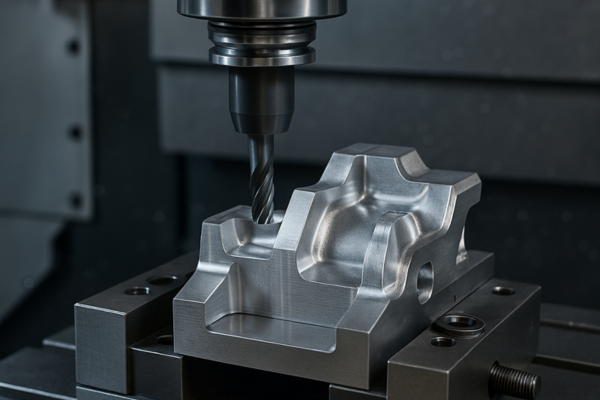
CNC machining sits behind a large share of the physical products in use today, from aircraft brackets and surgical instruments to the aluminum housing on a power tool. It is also one of the more misunderstood manufacturing methods among the people who buy it. Most confusion comes from the same places: what the process can realistically hold, why two quotes for the same part differ, and which machine a part actually needs.
This guide explains how CNC machining works from file to finished part, what each machine type does, where the process fits against alternatives, and what to look for in a supplier.
What Is CNC Machining?
CNC machining is a subtractive manufacturing process. A computer-controlled machine removes material from a solid block, bar, or plate using rotating cutting tools until the remaining shape matches a digital design. CNC stands for computer numerical control, meaning every tool movement is driven by programmed coordinates rather than by hand.
Three characteristics explain why the process is so widely used:
- Material range. Almost any metal or engineering plastic that can be cut can be machined
- Accuracy. Standard work holds around plus or minus 0.125 mm, and precision CNC machining routinely reaches plus or minus 0.025 mm or tighter
- Flexibility. No dedicated tooling is required, so one part or five thousand can run from the same program
How the CNC Machining Process Works
A part moves through the same sequence in almost every shop.
- CAD model and drawing. The designer supplies a 3D model, usually STEP format, and a 2D drawing carrying tolerances, threads, finishes, and material.
- Design review. The shop checks manufacturability: tool access, internal radii, wall thickness, and any tolerance that needs a special process.
- CAM programming. A programmer converts the model into toolpaths, choosing tools, speeds, feeds, and the order of operations. The output is G-code the machine reads.
- Setup and fixturing. The operator mounts the stock in a vise, chuck, or custom fixture, loads the tools, and sets the work coordinate origin.
- Machining. Roughing passes remove bulk material quickly. Finishing passes bring features to final size and surface quality.
- Deburring. Sharp edges and burrs left by cutting are removed by hand or in a tumbler.
- Inspection. Critical dimensions are measured against the drawing, often on a CMM for geometric tolerances.
- Finishing. Anodizing, plating, bead blasting, or other treatments are applied as specified.
The CNC machining process is only as reliable as steps two and four. Most parts that fail inspection trace back to a design feature nobody questioned or a setup datum picked up from the wrong face.
The Main Types of CNC Machines
CNC Milling
A milling machine holds the workpiece still while a rotating cutter moves across it. Mills produce flat faces, pockets, slots, holes, and complex 3D contours. A 3-axis mill moves the tool in X, Y, and Z. A 4-axis adds rotation around one axis, and a 5-axis mill adds two rotational axes so the tool can reach nearly any face in a single setup.
CNC Turning
A lathe spins the workpiece while a stationary cutting tool shapes it. Turning is the efficient choice for round parts: shafts, pins, bushings, and fittings. Live tooling on modern lathes adds small milled features such as flats and cross holes.
Other CNC Processes
| Machine | What it does | Typical parts |
| 3-axis mill | Machines from the top, repositioning for each face | Plates, brackets, simple housings |
| 5-axis mill | Reaches complex angles in one setup | Impellers, aerospace structures, medical implants |
| CNC lathe | Rotates the part against a fixed tool | Shafts, pins, spacers |
| Mill-turn center | Combines turning and milling in one machine | Complex round parts with milled features |
| Swiss-type lathe | Supports slender bar close to the cutting point | Small precision pins, medical screws, connectors |
| Wire EDM | Cuts with an electrically charged wire | Hardened steel, sharp internal corners, fine slots |
| CNC router | Light cutting over large areas | Sheet plastics, aluminum panels, composites |
Materials Used in CNC Machining
Aluminum 6061 is the most common choice, valued for its machinability, strength, and cost. Stainless steel, carbon and alloy steel, brass, copper, and titanium follow, each chosen for strength, corrosion resistance, conductivity, or weight. On the plastics side, acetal, nylon, PEEK, polycarbonate, and ABS cover most applications.
Material choice affects far more than strength. It drives machine time, tool wear, available finishes, and the tolerance a part can hold. The full list of stocked metals and plastics is on the materials page.
Tolerances and Precision
Most shops apply a default tolerance of around plus or minus 0.125 mm, or plus or minus 0.005 inch, to any dimension without a specific callout. Precision CNC machining reaches far tighter values, but they cost more, because they require slower finishing passes, more careful fixturing, and additional inspection.
| Tolerance level | Typical range | Common use |
| Standard | ±0.125 mm | General dimensions, non-mating features |
| Precision | ±0.025 mm | Bearing fits, mating parts, alignment features |
| High precision | ±0.005 mm or tighter | Aerospace, medical, optical components |
The practical rule is to apply tight tolerances only where function requires them. Every unnecessary tight callout adds cost without adding value.
Surface Finishes
A standard as-machined surface is around Ra 3.2 micrometers, with visible tool marks. From there, parts can be bead blasted for a uniform matte look, anodized for corrosion protection and color, plated, powder coated, or polished. The right choice depends on the environment the part lives in and whether it is visible. Options and material compatibility are listed on the surface finishing page.
Where CNC Machined Parts Are Used
CNC machined parts appear wherever accuracy, material performance, or low volumes rule out other processes.
- Aerospace. Structural brackets, housings, and fittings in aluminum and titanium
- Medical. Surgical instruments, implant components, and device housings
- Automotive. Prototype components, engine parts, and performance aftermarket parts
- Robotics and automation. End effectors, mounts, and precision motion components
- Electronics. Heat sinks, enclosures, and RF shielding
- Energy and industrial. Valve bodies, pump components, and tooling
Each sector brings its own documentation and certification expectations, which is why suppliers usually list the industries they serve alongside their capabilities.
CNC Machining Compared With Other Processes
| Factor | CNC machining | 3D printing | Injection molding | Sheet metal |
| Best quantity | 1 to several thousand | 1 to a few hundred | Thousands and up | 1 to thousands |
| Tooling cost | None | None | High | Low |
| Tolerance | Tight | Moderate | Moderate | Moderate |
| Material properties | Full, from solid stock | Process dependent | Full, resin dependent | Full |
| Geometry limits | Tool access | Very few | Draft and uniform walls | Bend radii, flat patterns |
Custom CNC machining wins when the part needs tight tolerances, real engineering materials, and low to medium volume. Injection molding takes over when quantities climb into the thousands and the tooling cost can be spread across the run.
What to Look for in CNC Machining Services
The quality of a machined part depends as much on the shop as on the machine. When comparing CNC machining services, check for:
- Machine range. Whether the shop runs 5-axis, mill-turn, or Swiss equipment if the part needs it
- Engineering review. A shop that flags manufacturability problems before quoting saves time later
- Inspection capability. CMM access, calibrated equipment, and the ability to provide inspection reports
- Quality certification. ISO 9001 as a baseline, AS9100 or ISO 13485 for regulated work
- Finishing support. In-house or managed finishing avoids a second supplier and a shipping leg
- Communication. Clear lead times, prompt responses, and a single point of contact
For custom CNC machining projects that need to scale from prototype to production, a supplier able to support both stages avoids requalifying parts at the transition. Engineering teams sourcing precision components can review capabilities and request a design review from XC Machining before releasing a drawing.
FAQs
Q: What does CNC stand for?
A: CNC stands for computer numerical control. It means the machine’s movements are directed by programmed coordinates, usually G-code generated from a CAD model, rather than by manual operation. This allows complex shapes to be produced accurately and repeatedly.
Q: How long does CNC machining take?
A: Simple parts can be machined and shipped within a few days. Complex parts, tight tolerances, or added finishing and inspection typically extend lead times to one to three weeks. Quantity, material availability, and machine scheduling also affect the timeline.
Q: Is CNC machining suitable for one-off parts?
A: Yes. Because no dedicated tooling is required, CNC machining is one of the most economical ways to produce single prototypes and small batches. The main cost for one-off parts is programming and setup time, which is spread across fewer pieces.
Q: What file format should I send for a CNC quote?
A: A STEP file for the 3D geometry plus a PDF drawing for tolerances, threads, finishes, and material. Formats such as IGES, Parasolid, and native CAD files are often accepted, but STEP is the most universally compatible option.
Q: What is the difference between 3-axis and 5-axis machining?
A: A 3-axis machine moves the tool in three linear directions, so complex parts need several setups. A 5-axis machine adds two rotational axes, reaching angled features in one setup. This improves accuracy between features and reduces handling time.