CNC machining in Polycarbonate

High machinability and ductility, good strength-to-weight ratio.

CNC machining in Polycarbonate

High machinability and ductility, good strength-to-weight ratio.

Description

Application
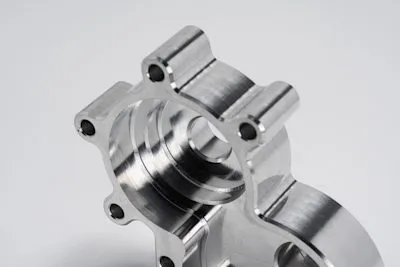
CNC machining produces parts with excellent mechanical properties, accuracy and repeatability from metal and plastic. 3-axis & 5-axis CNC milling available.
Strengths
Excellent mechanical properties, High accuracy & repeatability
Weaknesses
Greater geometry restrictions than 3D printing

Properties

Lead Time
< 10 days
Wall Thickness
0.75 mm
Tolerances
±0.125mm (±0.005″)
Max part size
200 x 80 x 100 cm

Available Aluminum Materials

Property Value Mechanical Properties Ultimate tensile strength 110 – 210 MPa Yield

Property Value Mechanical Properties Ultimate tensile strength 210 – 270 MPa Yield

Property Value Mechanical Properties Ultimate tensile strength 140 – 280 MPa Yield

Property Value Mechanical Properties Ultimate tensile strength 120 – 215 MPa Yield

Property Value Mechanical Properties Ultimate tensile strength 520 – 560 MPa Yield

Property Value Mechanical Properties Ultimate tensile strength 260 – 310 MPa Yield

Ready to Elevate Your Project?

Bring Your Designs to Life with XC Machining

Experience precision engineering with XC Machining. From detailed prototypes to high-volume production, we’re here to turn your concepts into reality. Contact us today to discuss your project needs!

Related Articles and Insights

Dive Deeper with Articles and Posts Connected to Your Interests

Frequently Asked Questions

Aluminum 6063

  • What temper of Aluminum 6063 is best for machining?

    6063-T6 is generally preferred for CNC machining because it offers higher strength and better dimensional stability than softer tempers like T4 or T5. XC Machining can work with any temper, but T6 provides the best balance between machinability and final performance. 

  • Does Aluminum 6063 resist corrosion outdoors?

    Yes. 6063 has excellent natural corrosion resistance and is widely used outdoors for window frames, door systems, railings, and architectural structures. Anodizing further enhances its resistance to weather, moisture, and UV exposure, making it ideal for long-term outdoor use. 

  • Can Aluminum 6063 be CNC machined, or is it only suitable for extrusion?

    Although 6063 is known as an extrusion alloy, it machines very well. It produces smooth chips, low tool wear, and stable dimensional accuracy when machined. XC Machining frequently extruded 6063 profiles to add precision features, pockets, and mounting holes. 

  • Why does Aluminum 6063 anodize better than other alloys like 6061?

    6063 has a balanced magnesium–silicon composition that produces a smoother surface after extrusion and machining. This fine grain structure allows anodizing to develop more evenly, resulting in better color uniformity, higher clarity, and better overall aesthetic quality than 6061. 

  • Is Aluminum 6063 strong enough for structural applications?

    Yes, especially in T5 and T6 temper conditions. While it is not as strong as 6061, Aluminum 6063 offers sufficient strength for architectural frames, railings, brackets, and structural profiles. It is widely used in construction, automotive trim, and industrial assemblies where formability and surface finish matter more than maximum strength. 

en_USEnglish
Send Us detail Requirements
