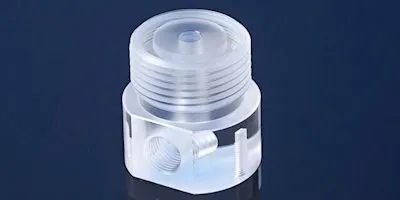
CNC machining in Polycarbonate

Transparent rigid plastic often used as a substitute for glass.

CNC machining in Polycarbonate

Transparent rigid plastic often used as a substitute for glass.

Description

Application
CNC machining produces parts with excellent mechanical properties, accuracy and repeatability from metal and plastic. 3-axis & 5-axis CNC milling available.
Strengths
Excellent mechanical properties,High accuracy & repeatability
Weaknesses
Greater geometry restrictions than 3D printing

Properties

Lead Time
< 10 days
Wall Thickness
0.75 mm
Tolerances
±0.125mm (±0.005″)
Max part size
200 x 80 x 100 cm

Available PMMA (Acrylic) Materials

Property Value Mechanical Properties Ultimate tensile strength 55 – 83 MPa Yield

Ready to Elevate Your Project?

Bring Your Designs to Life with XC Machining

Experience precision engineering with XC Machining. From detailed prototypes to high-volume production, we’re here to turn your concepts into reality. Contact us today to discuss your project needs!

Related Articles and Insights

Dive Deeper with Articles and Posts Connected to Your Interests

Frequently Asked Questions

PMMA (Acrylic)

  • Is PMMA shatter-resistant like polycarbonate?

    PMMA is more impact-resistant than glass but less impact-resistant than polycarbonate. While it can handle moderate impacts without breaking, it may crack under high stress or sudden force. For applications requiring extreme toughness, such as protective shields or safety barriers, polycarbonate is superior. However, when clarity and scratch resistance are the priority, PMMA is the better choice. 

  • Can PMMA withstand outdoor UV exposure for long periods?

    Yes, PMMA is naturally UV-resistant and does not yellow easily in sunlight. Its excellent weathering performance makes it suitable for outdoor signs, lighting covers, windows, and architectural installations. With proper coatings, PMMA can maintain clarity and durability for many years even in harsh outdoor conditions. 

  • Does PMMA scratch easily, and can scratches be repaired?

    PMMA is more scratch-resistant than many transparent plastics but can still develop fine scratches from abrasion. The good news is that light scratches can often be removed through polishing, sanding, or buffing. XC Machining offers polishing services to restore PMMA components to their original clarity when needed. 

  • Is PMMA safe for medical and laboratory applications?

    Yes, PMMA is biocompatible, chemically stable, and resistant to sterilization chemicals, making it suitable for medical devices, diagnostic windows, cuvettes, and laboratory components. Its high clarity allows easy visual inspection of fluids or samples, which is essential in clinical and research environments. 

  • Can PMMA be glued, bonded, or welded during assembly?

    PMMA can be bonded using solvent-based adhesives, UV-curable glues, or mechanical fastening. However, some aggressive solvents may cause stress cracking or crazing if applied incorrectly. XC Machining provides guidance on the safest adhesives and assembly techniques to maintain clarity, strength, and part stability. 

en_USEnglish
Send Us detail Requirements
