
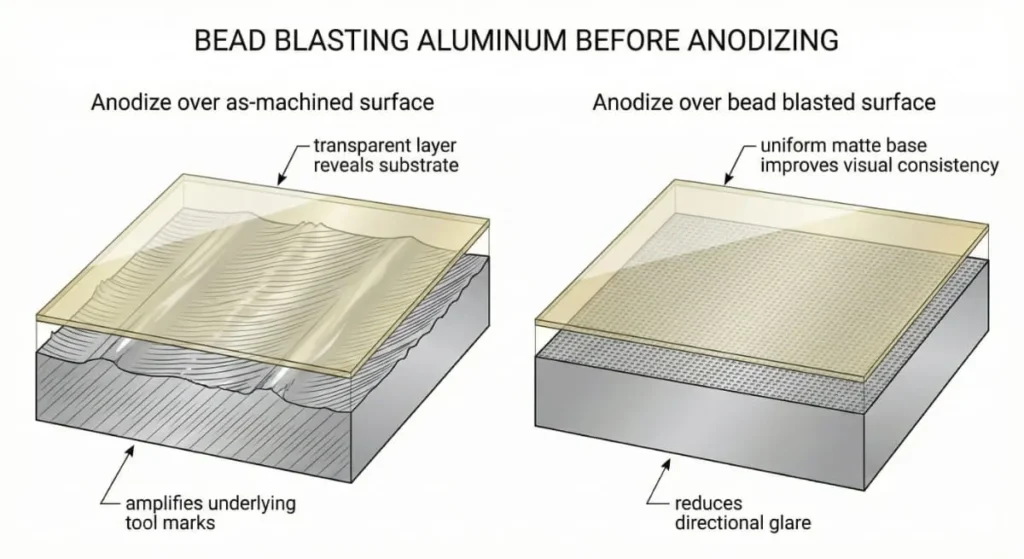
Bead blasting and anodizing do two different jobs, so the best aluminum finish often uses both. Bead blasting is a mechanical process that creates a uniform matte texture and hides machining marks, but it adds no protection and leaves bare aluminum. Anodizing is an electrochemical process that builds a hard, corrosion-resistant oxide layer and can add color, but on its own it can highlight tool marks underneath.
The premium finish you see on most quality aluminum products—an even matte surface with color and durability—is bead blasting followed by anodizing, not one instead of the other.
1. What does each process actually do?
Bead blasting textures the surface, and anodizing coats and protects it. Bead blasting propels fine glass beads or other media at the aluminum, peening the surface into a uniform satin or matte texture that masks small scratches and machining lines. It changes appearance and feel but leaves the metal chemically unchanged and unprotected.
Anodizing submerges the part in an acid bath under electrical current, converting the surface into a hard aluminum oxide layer that resists corrosion and wear and can absorb dye for color.
Because one is texture and the other is protection plus color, comparing them as alternatives misses the point for most parts. They solve different problems.
2. Bead blasting alone vs anodizing alone
Used alone, bead blasting gives a uniform raw-metal look with no durability, while anodizing alone protects the part but can show whatever surface was underneath.
-
Bead-Blasted Only: A part that skips anodizing has an attractive even finish on day one, but the bare aluminum will oxidize, fingerprint, and scratch over time.
-
Anodized Only: An as-machined part that goes straight to anodizing without blasting gets protection and color, but the anodic layer is semi-transparent. Consequently, visible tool marks, fixturing witness lines, and surface variation can telegraph through the finish.
| Finish | Appearance | Protection | Color | Hides Tool Marks |
| Bead blast only | Uniform matte, raw metal | None | No | Yes |
| Anodize only | Depends on surface beneath | Yes | Yes | No |
| Bead blast + anodize | Uniform matte, colored | Yes | Yes | Yes |
3. Why are the two usually combined?
Bead blasting before anodizing produces the most consistent, professional finish, which is why it is the standard sequence for quality aluminum CNC machining products. The blast step evens out the surface and removes machining evidence, so when the anodize goes on, the color lands uniformly and the part looks intentionally finished rather than just coated. This blast-then-anodize combination is what gives consumer electronics, instrument housings, and premium hardware their characteristic smooth matte colored surfaces.
The order matters. Blasting happens first because doing it after anodizing would damage the oxide layer. If your drawing dictates this workflow, read our guide on how to call out anodizing on a drawing to ensure the sequence is specified so there is no ambiguity.
4. How does blasting media change the final look?
The bead size and media type set the texture, from a fine satin to a coarser matte. Finer glass beads produce a smooth, soft satin appearance, while coarser media or aluminum oxide grit creates a more aggressive matte texture.
The texture also affects how the anodize reads: a finely blasted surface anodizes to a refined, even color, while a coarse blast gives a deeper matte that can make a color look slightly different from the same dye on a smooth part. If color matching across parts matters, the blast spec needs to be consistent, not just the dye color.
For cosmetic parts, it is worth requesting a sample or specifying the media and pressure so the finish is repeatable across a production run.
5. Cost and lead time
Adding bead blasting before anodizing adds a processing step and modest cost, but it is usually worth it for visible parts. Bead blasting is a relatively inexpensive operation, and anodizing pricing depends mostly on type, color, and part size.
Doing both adds lead time for the extra handling but rarely changes the economics enough to skip blasting on a cosmetic part. For hidden or purely functional parts, performing standard CNC machining and anodizing directly over an as-machined surface is often perfectly acceptable and saves a step.
6. Which finish should I specify for my part?
Match the finish to whether the part is seen and whether it needs protection. Use the quick logic below:
-
Visible, premium part: Bead blast, then anodize (Type II Class 2 for color). This is the standard for product housings.
-
Functional, hidden part needing protection: Anodize only, over an as-machined surface. This saves an extra processing step.
-
Appearance only, no durability needed: Bead blast only, but expect the raw aluminum to age over time.
-
Wear surface: Type III hardcoat, with or without a light blast depending on cosmetics. Be sure to evaluate the potential anodizing dimensional change to keep critical part dimensions within your design constraints.
At XC Machining, extensive surface finishing services—including bead blasting, anodizing, and combined finishes—are handled in-house. Our team will recommend the right sequence for your part during the quote stage so the finish perfectly matches the application.
7. Frequently Asked Questions
Is bead blasting the same as anodizing?
No. Bead blasting is a mechanical process that creates a matte texture, while anodizing is an electrochemical process that builds a protective, colorable oxide layer. They do different jobs and are often used together.
Should I bead blast before or after anodizing?
Before. Blasting evens out the surface and hides machining marks so the anodize lands uniformly. Blasting after anodizing would damage the oxide layer.
Does bead blasting protect aluminum from corrosion?
No. Bead blasting only changes texture and appearance, leaving bare aluminum that will oxidize and scratch over time. For protection, the part needs anodizing or another coating.
Why do anodized parts sometimes show machining marks?
Because the anodic layer is semi-transparent and follows the surface beneath it. Without a bead-blast or polishing step first, tool marks and witness lines can telegraph through the finish.
What finish gives the smooth matte look on consumer products?
Bead blasting followed by Type II Class 2 anodizing. The blast creates the uniform matte texture and the anodize adds color and protection, producing the characteristic premium finish.
Sources
-
US Department of Defense, MIL-A-8625F, Anodic Coatings for Aluminum and Aluminum Alloys
-
ASTM B580, Standard Specification for Anodic Oxide Coatings on Aluminum
-
SAE AMS2430, Shot Peening / blast finishing practice references
About the Author
The XC Machining Engineering Team finishes machined aluminum parts in-house with bead blasting, anodizing, and combined finishes for cosmetic and functional applications. To get started on a project, you can quote a finished aluminum part directly through our platform.