
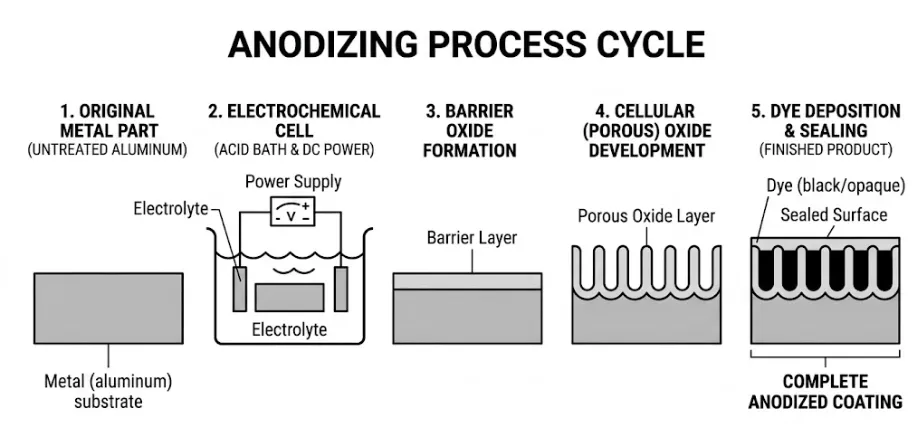
A complete anodizing callout names the type, class, color, thickness with tolerance, and whether dimensions apply before or after finishing, all referenced to MIL-A-8625. A correct example reads: “Anodize per MIL-A-8625 Type II Class 2, color black, 0.0005 to 0.0008 inch thick, dimensions after anodize.” That single line tells the anodizer exactly which process to run and tells the machinist whether to pre-compensate for buildup. The most common cause of rejected anodized parts is not a bad process, it is an incomplete callout that left the shop guessing.
What are the five elements of a complete anodizing callout?
Every anodizing callout needs the specification, type, class, color and thickness, and a dimension reference. Leave any one out and the anodizer has to make an assumption, which is where parts go wrong. The five elements are:
-
Specification: MIL-A-8625 (the standard nearly every US anodizer works to).
-
Type: I, II, or III, which sets the process and coating thickness range.
-
Class: 1 (undyed) or 2 (dyed), which sets whether the part is colored.
-
Color and thickness: the dye color and a thickness with a tolerance.
-
Dimension reference: whether toleranced dimensions are before or after anodize.
Adding a sealing requirement and a RoHS note when relevant rounds out a production-ready callout.
Type and class explained
Type defines the process and thickness, class defines color. Type I uses a chromic acid bath and produces the thinnest coating, Type II uses sulfuric acid for general-purpose and decorative finishes, and Type III is a low-temperature sulfuric process that produces a thick, hard wear coating. Class 1 means the part is left in its natural undyed state, and Class 2 means it is dyed to a specified color.
| Designation | Meaning | Typical Thickness | Common Use |
| Type I | Chromic acid | 0.00002–0.0001 in | Fatigue-critical, tight tolerance, paint base |
| Type II | Sulfuric acid | 0.0002–0.001 in | Decorative color, general corrosion |
| Type III | Hardcoat | 0.001–0.003 in | Wear surfaces, dielectric |
| Class 1 | Undyed | n/a | Natural, clear, or hardcoat |
| Class 2 | Dyed | n/a | Color required |
Note: Thickness ranges per MIL-A-8625.
So “Type II Class 2” means a sulfuric-acid decorative anodize that will be dyed, while “Type III Class 1” means an undyed hardcoat. Pairing the wrong type and class, such as asking for a bright color on a thick hardcoat, leads to surprises because hardcoat colors run darker and less predictable.
How do I specify color and thickness?
State the color by name and the thickness as a range, not a single number. “Black” is clear; “dark” is not. For thickness, a single value like “0.001 inch” invites the anodizer to hit anywhere near it, while a range like “0.0008 to 0.0012 inch” controls the buildup that affects your dimensions. On dyed parts, note if color matching across a batch or to a sample is required, since dye lots and alloy chemistry shift the final shade.
Be aware that color and type interact. Type II takes rich, consistent colors because the porous layer absorbs dye well. Type III hardcoat is naturally darker (bronze to gray to near black even undyed), so a bright color is hard to achieve on it. If you need both a hard wear surface and a specific bright color, that is a conversation to have with the finisher before you finalize the drawing.
Before or after anodize: the dimension note
State whether toleranced dimensions apply before or after anodizing, because the coating changes the size. This is the single most valuable line on the drawing. Anodizing grows the part by roughly half the coating thickness per surface, so a dimension that is in tolerance before anodize can be out of tolerance after.
If the note says “dimensions after anodize,” the machinist pre-compensates the cut during aluminum CNC machining. If it says “before anodize,” the inspector measures before the part is coated. Either is fine. Saying nothing is what causes rejects.
For parts with tight tolerances, also call out which surfaces should be masked. See our complementary guides on anodizing dimensional change and press fit tolerances for the detailed math behind structural coating growth.
Masking and selective anodizing callouts
Use a masking note to keep specified surfaces bare, such as threaded holes, grounding pads, or press-fit bores. A clear callout reads: “Mask threaded holes and bore Ø10.00, no anodize.” Masking adds cost and the boundary between masked and anodized areas is never perfectly sharp, so call out a tolerance zone for the mask edge if the boundary location matters. For electrical grounding, note “bare for electrical contact” so the anodizer understands the functional reason and does not seal over the area.
Ready-to-use anodizing callout examples
Copy and adapt these complete callouts for your engineering drawings:
-
Decorative black, general purpose:
Anodize per MIL-A-8625 Type II Class 2, color black, 0.0005 to 0.0008 in thick, sealed, dimensions after anodize. -
Clear protective:
Anodize per MIL-A-8625 Type II Class 1, clear, 0.0003 to 0.0006 in thick, sealed. -
Hardcoat wear surface:
Hardcoat anodize per MIL-A-8625 Type III Class 1, 0.002 in thick (0.001 in per surface), dimensions after anodize. Mask bearing bore Ø20.00, no anodize. -
Aerospace tight tolerance:
Anodize per MIL-A-8625 Type I Class 1, chromic, per applicable drawing notes. Dimensions apply as machined.
A drawing note block that pairs the finish callout with the masking note and the dimension reference removes essentially all of the back-and-forth that delays fabrication schedules.
Frequently Asked Questions
What specification governs anodizing callouts? MIL-A-8625 is the US standard that defines anodizing types and classes and is referenced on nearly every anodizing callout. It covers Type I chromic, Type II sulfuric, and Type III hardcoat, along with Class 1 undyed and Class 2 dyed.
What does “Type II Class 2” mean on a drawing? It means a sulfuric-acid decorative anodize (Type II) that is dyed to a specified color (Class 2). You still need to add the color name and a thickness range to complete the callout.
Do I need to specify thickness if I just want it anodized? Yes. Thickness controls both wear performance and dimensional buildup. A range like 0.0005 to 0.0008 inch gives the anodizer a target and protects your tolerances. Leaving it off means the result can vary part to part.
How do I keep threads from being affected by anodizing? Add a masking note such as “mask threaded holes, no anodize,” or specify tapping after anodize. This keeps oxide buildup out of the threads so standard fasteners fit.
Can I specify a color on Type III hardcoat? Hardcoat colors are limited and run dark because the coating is naturally bronze to black even undyed. If a specific bright color is required, discuss it with the finisher before finalizing, or use Type II where color matters.
Sources
-
US Department of Defense, MIL-A-8625F, Anodic Coatings for Aluminum and Aluminum Alloys
-
ASTM B580, Standard Specification for Anodic Oxide Coatings on Aluminum
-
SAE / ASME drawing practice for surface finish and coating callouts
About the Author
The XC Machining Engineering Team reviews thousands of machined-part drawings each year and provides professional DFM feedback on finishing specifications before production. If you want a comprehensive check on your drawing notes, you can upload your files directly for our engineers to perform an offline anodizing and drawing callout review. For full production pricing, navigate to our complete industrial anodizing and finishing services or get a quote instantly.